Outfinity cultural artefacts · investor reading shelf
Seven books for a different AI future.
These books explain the institutional, technical and cultural thesis behind Outfinity. Together, they ask how a venture studio can build category brands, shared infrastructure and decentralised cooperation without becoming another closed platform.
Investment doctrine
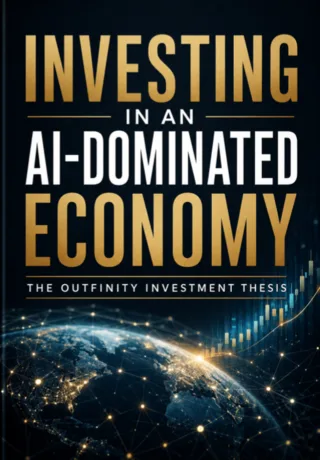
Investing in an AI-Dominated EconomyThe Outfinity Investment Thesis
This is the strategic doctrine behind Outfinity Venture Studio. It starts from a difficult observation: as models and software features become easier to produce, useful applications may multiply while the number of independent companies capable of exceptional returns contracts. The book explains why durable positions need something harder than access to intelligence—research frontiers, governed execution, lawful learning rights, accountable reputation, regulation, distribution or an ecosystem-scale brand.
It then sets out how Axiologic Research and Outfinity turn long-term technical and institutional work into venture options, and why Metacult, Outfinitism and decentralised brands are operating principles rather than decorative ideas.
Read the book ↗Institutional design
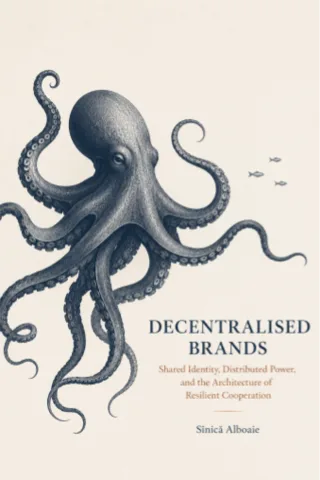
Decentralised BrandsShared Identity, Distributed Power, and the Architecture of Resilient Cooperation
A brand is more than advertising. It is a social technology that joins a name to memory, expectations, trust and the authority to act under a common promise. This book asks how that power can be shared by autonomous organisations and projects without becoming the private sovereignty of one company—or an undefended commons that returns little to those who sustain it.
Linux, Bitcoin, Wikipedia and federated networks are treated as laboratories, not templates. The focus is legitimacy: what makes a centre useful yet bounded, contestable and replaceable; how local initiative can remain real; and how shared reputation can distribute gains more fairly.
Read the book ↗Social technology
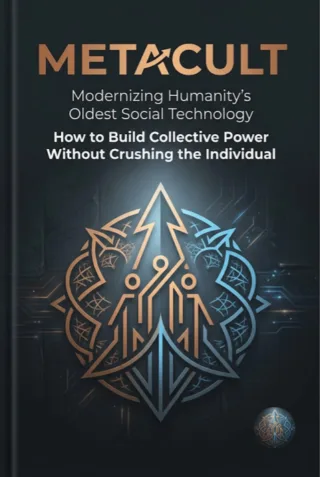
MetacultModernizing Humanity's Oldest Social Technology
How to Build Collective Power Without Crushing the Individual
Metacult introduces a name for a problem that modern organisations often avoid: people accomplish difficult things through collective identity, memory, membership and shared purpose. The question is not whether that force exists. The question is whether it can be made more conscious, humane and corrigible than the destructive cults, sects and empires of the past.
For Outfinity, the book explains how a mission can gather contributors and resources without turning participants into instruments. It connects the stakes of AI, social fragmentation and institutional change to a practical choice for entrepreneurs and investors: learn to build collective power responsibly, or leave that power to less responsible actors.
Read the book ↗Entrepreneurial doctrine
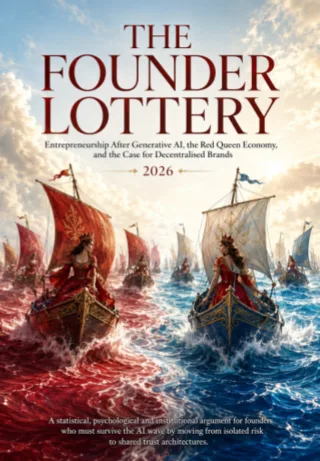
The Founder LotteryEntrepreneurship After Generative AI, the Red Queen Economy
A call to entrepreneurs and investors to define reality more clearly and make the case for reason. The book does not deny that emotion, ambition and the thrill of the game can be stronger than reason in the moment. It asks what that attraction costs when startup outcomes resemble a lottery and generative AI multiplies the number of people able to enter the race.
At the scale of the change now confronting humanity, entrepreneurship will have to be reconsidered sooner or later as AI becomes a dominant economic force. Continuing the theory and vision of Decentralised Brands, this is a more direct, applied argument: founders and investors must move beyond isolated risk toward shared trust architectures, institutions and games that distribute opportunity more fairly.
Read the book ↗Legal architecture
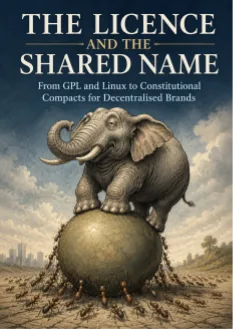
The Licence and the Shared NameFrom GPL and Linux to Constitutional Compacts for Decentralised Brands
This book connects the history of free software, the GPL, open source and Linux with a forward-looking design question: how can a shared name, reputation and economic position survive beyond one centre without becoming either a proprietary monopoly or an easily exploited commons?
It proposes the Decentralised Brand Compact as a research architecture, not a finished licence or legal solution. Software licences, trademark custody, contribution governance, provenance, forks and the right to claim continuity under a shared name must be designed as distinct instruments. Any real implementation needs jurisdiction-specific legal work and empirical testing.
Read the book ↗Network future
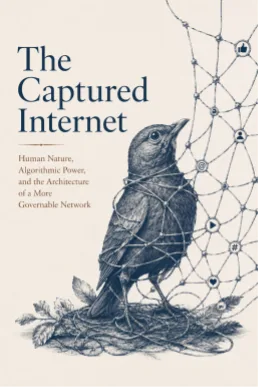
The Captured InternetHuman Nature, Algorithmic Power, and the Architecture of a More Governable Network
Imagine an internet that continues to function perfectly while becoming progressively less worth entering. This book begins with that unease: an environment can be technically efficient yet still narrow human agency, capture attention, intensify status conflict and make public life harder to govern.
The argument looks at human nature and algorithmic power, then develops alternatives compatible with the Outfinity Venture Studio vision: systems that keep discovery, collaboration, culture and economic participation open to contestation rather than allowing a few platforms to define the social field.
Read the book ↗Philosophy
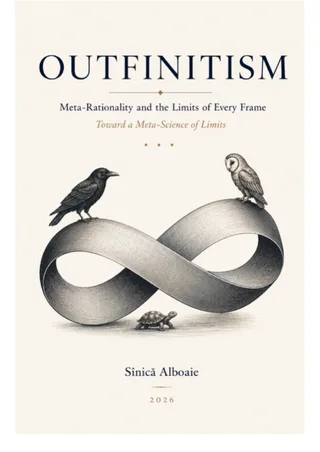
OutfinitismMeta-Rationality and the Limits of Every Frame. Toward a Meta-Science of Limits
Outfinitism begins with a limited author writing about limits. It asks that the limits of models, evidence, computation, measurement, prediction, institutions, bodies and authority remain visible—including the blind spots and desires that shape the person making the argument.
Meta-rationality is the wider capacity to examine the frame that makes an act of reasoning meaningful. Outfinitism concentrates that inquiry on boundaries: the open succession of finite attempts to understand and act, rather than a final model that mistakes its frame for nature.
The book is not a finished doctrine or an established discipline. It offers a vocabulary, a small formal core and a direction for research—one intended to be criticized, corrected, divided and, if necessary, replaced by a better framework. Its use of AI follows the same principle: a finite author using a powerful but limited instrument without treating it as an oracle.
Read the book ↗